
Some days he lets you in. Some days you're just another guy with a camera. That part's not up to you.
It's 4am, I'm barefoot on a road that has personally wronged my feet, and somewhere behind me a stranger is singing to a mountain in the dark. That's Girivalam, at the bottom of a hill that Tamil Nadu insists is a god. Nobody warned me it would feel like this. I've been coming back to Annamalaiyar Temple long enough now that I've stopped expecting anyone to warn me about anything — I just go, and the place rearranges something in me every single time. Here's why I can't stay away, told the way it actually happened, not the way a brochure would tell it.
The hill got there first
Most temple towns, you visit the temple and that's the trip. You take the photo, you buy the prasadam, you leave. Tiruvannamalai doesn't let you off that easy, and I found that out the hard way — I'd planned my first visit like any other temple stop, in and out, back on the road by noon. Then I stood near the eastern tower, looked up, and realized the entire town was arranged around a hill, not the temple. The building wasn't the point. It never had been.
The temple sits at the base of Arunachala, and the hill itself is treated as Shiva — not a scenic backdrop somebody built a shrine in front of, the actual deity, just in mountain form. And this isn't a soft, decorative kind of powerful. The legend goes that Brahma and Vishnu once argued over which of them was supreme — as gods apparently do — and Shiva settled it by showing up as an infinite column of fire with no beginning and no end, too vast for either of them to measure. Arunachala is what that column of fire is said to have cooled into. Not a monument to Shiva. Shiva, mid-argument-ending, permanently. I didn't fully believe that the first time I heard it. I believed it a lot more standing at the base of the hill at sunrise, watching the whole town go quiet around it like it still remembered.
Annamalaiyar is one of the Pancha Bhoota Sthalams — the five temples tied to the five elements — and this one's element is Agni, fire. I filed that away as trivia until I got to the part of this story where they set the actual mountain on fire once a year. More on that later. For now, just sit with the fact that the "backdrop" has a temper.
Then the building shows up, and it's showing off
By the time you've accepted that the hill is the main character, the temple itself arrives to remind you it's not exactly a footnote either. The complex is enormous — around 10 hectares, one of the largest in the country — and nobody sat down and drew up a single master plan. Inscriptions trace it back to the Cholas, roughly 850–1280 CE, with Vijayanagara-era rulers piling on major sections centuries later like the world's slowest group project, one where nobody ever said "I think we have enough gopurams now."
You can see the seams as you walk through it — different towers, different mandapams, clearly different eras arguing quietly with each other about how much stone is too much stone. The eastern Rajagopuram is the one that gets you first — 11 storeys, around 66 metres, visible before you've technically arrived, like the temple is checking your ETA before you've checked in. I've seen a lot of gopurams by now. This is still the one that makes me stop mid-sentence and just look.
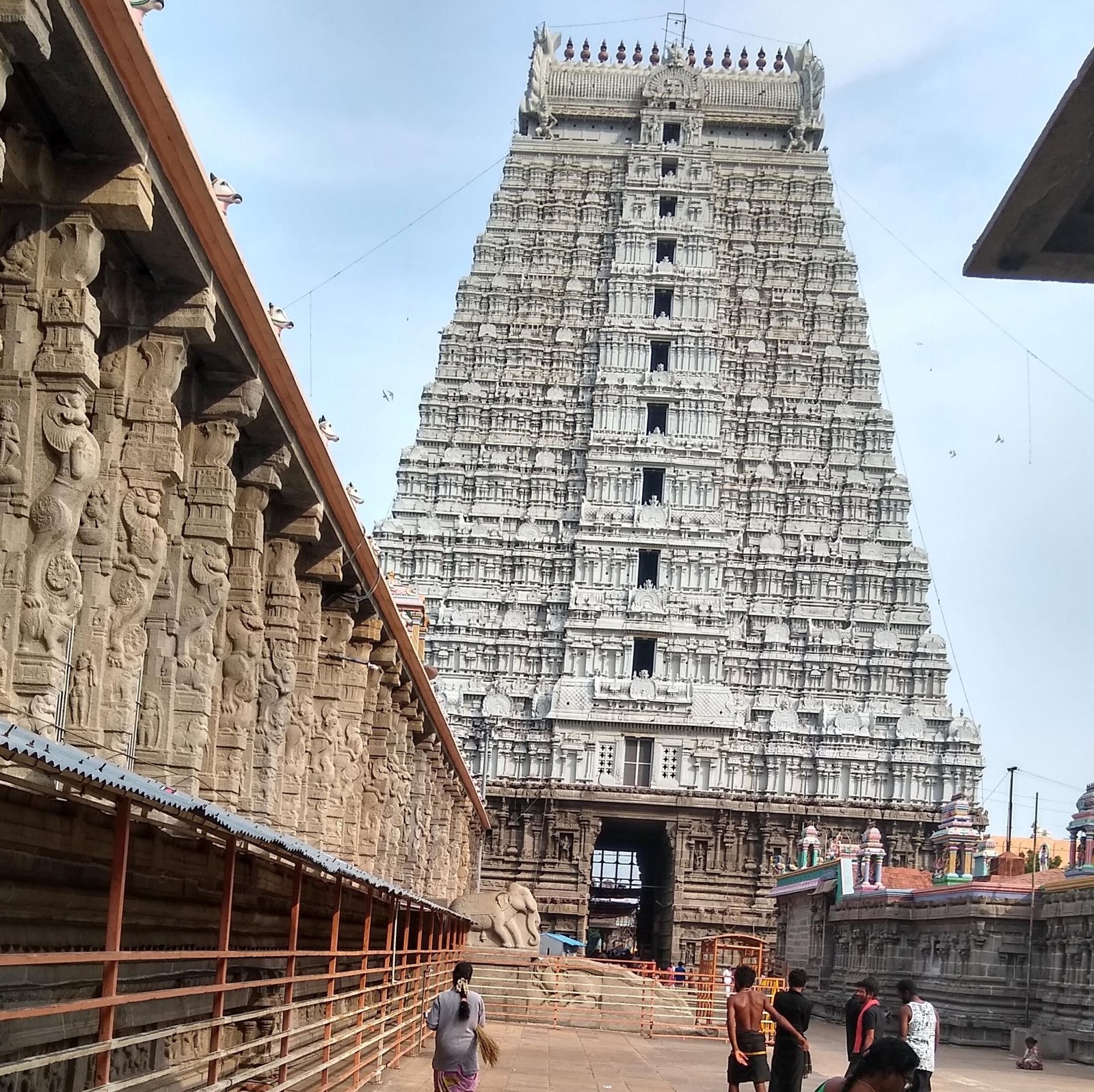
Photo: N. Vivekananthamoorthy, CC BY-SA 4.0, via Wikimedia Commons.
The ten minutes I'd never give up
Past the gopuram it opens into courtyard after courtyard — thousand-pillared halls, a shrine to Unnamalai Amman, more carved stone than one visit can properly absorb. Everyone talks about the towers. I go straight for the temple tank. It's the one place in the whole complex that's gone quiet — still water, the stonework folded into its own reflection, a pause button in the middle of something otherwise this dense and this loud. If you gave me ten minutes in the entire complex and told me I had to choose, I wouldn't hesitate, and I wouldn't feel bad about everything I skipped to get there.
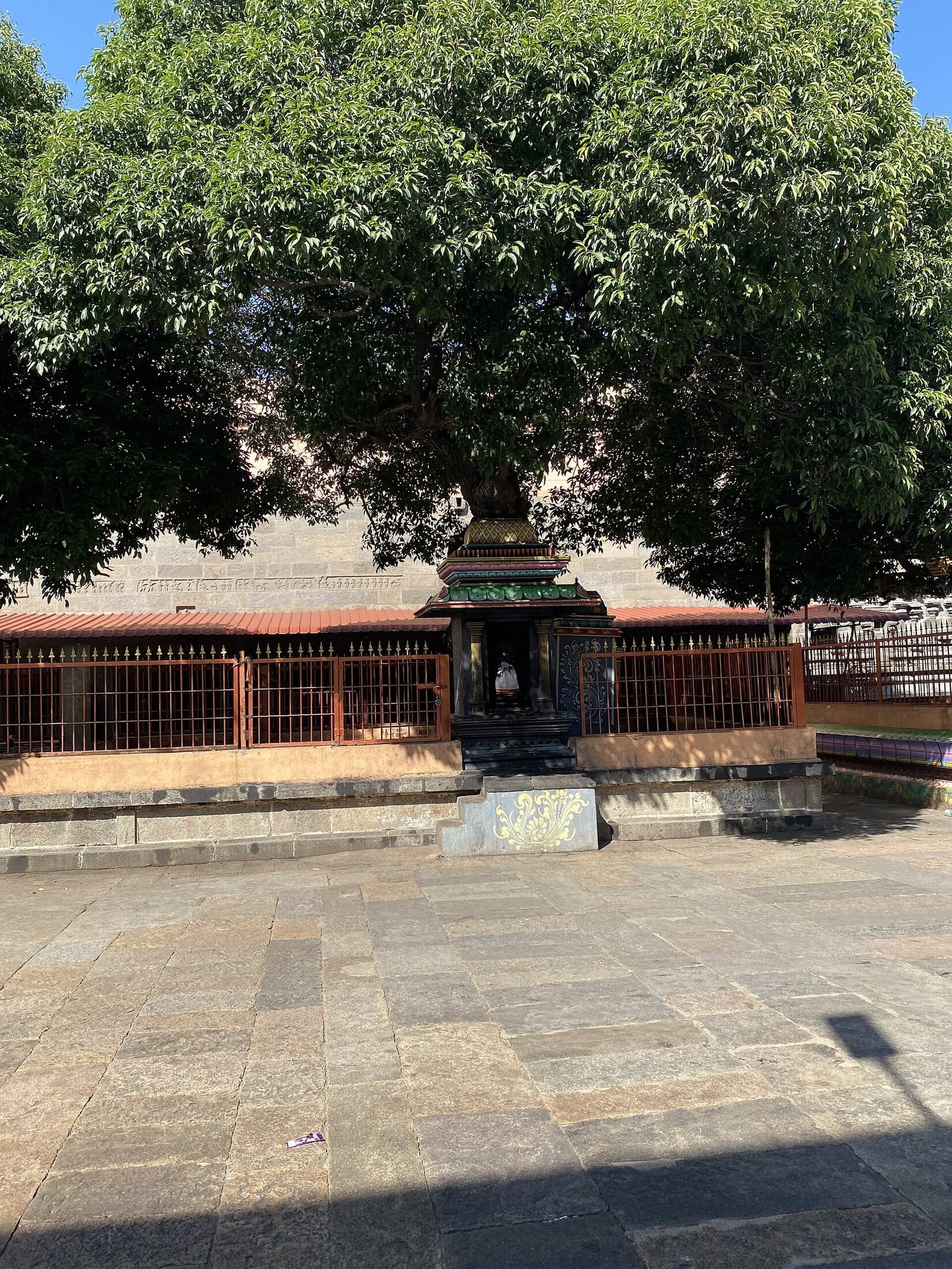
Photo: Vinayaraj, CC BY-SA 4.0, via Wikimedia Commons.
The walk that ruined every other walk for me
Which brings me back to 4am and my feet. Girivalam is the roughly 14-kilometre walk around the entire base of Arunachala, traditionally done barefoot, traditionally regretted by kilometre three and every kilometre after. Nobody warns you about the tar road at noon. They just let you find out, the way the mountain apparently finds out everything about you first and tells you never.
I did my first full moon Girivalam almost by accident — a friend talked me into it, I assumed it'd be a nice evening walk. It was tens of thousands of people shuffling around the hill together in the dark, half of them looking genuinely blissed out, the other half clearly just realizing what they'd signed up for. I was solidly in the second group for the first two hours. Somewhere after that, I stopped noticing my feet and started noticing the singing, the strangers, the sheer size of the thing moving slowly around a mountain at 2am for no reason except that it mattered to all of them. I don't fully know when it stopped being a walk and started being the whole reason I keep coming back. But it did.
The one I still haven't managed
Once a year, usually November–December, somebody climbs an entire mountain and sets the top of it on fire. On purpose. Ghee and camphor by the tanker-load for Karthigai Deepam, a flame visible for miles, burning for days like the organizers actively enjoy watching things combust. Given the whole site runs on the element of fire, this was never a metaphor dressed up for a brochure — it's an actual, enormous, actually-on-a-mountain fire.
I've tried to time a trip for it twice now. Once work ran long and I missed the window. Once I simply blinked and the dates were gone before I'd booked anything. I've started to take the pattern personally — like maybe you don't get invited to that one until he's good and ready to have you there. It's still at the top of my list, filed just above "learn to say no to a third helping of prasadam," a goal I have never once achieved and will probably die not achieving.
The quiet building next door
One more layer I didn't expect the first time I went: Ramana Maharshi settled at the base of Arunachala in the 20th century, and Sri Ramanasramam still pulls people in from all over the world for a teaching built on self-inquiry rather than ritual — no fire, no gopurams, no queue, just people sitting very still and staring down their own thoughts like it's a competitive sport. I wandered in expecting five minutes and stayed an hour, not doing anything, just sitting in a room that had clearly seen a lot of people go very quiet. It's a different register entirely from the temple, and having both within walking distance of each other is basically Tiruvannamalai's way of covering every mood you might show up in.
Why I actually keep coming back
Here's the part I still can't fully explain, even to myself. It's a mountain worshipped as an actual god, not a temple with good landscaping. It's a complex built by dynasties who took turns one-upping each other across four centuries. It's a walk that turns an entire hillside into the sanctum, at 2am, with strangers. It's a fire festival I keep almost making it to. It's a quiet room next door where nobody's asking anything of you. I don't think I've been anywhere else in India that stacks this much onto one place, and every time I go, I notice something I missed the last time.
There's also my grandfather's theory, which I have never been able to disprove: you don't decide to visit Annamalai, Shiva calls you, and when he calls, you go — and if you actually make it there and back, you walk out with moksha included, no extra charge. As a kid I filed that under "things elders say to make temple trips sound cooler than they are." As an adult who has now made this trip an unreasonable number of times, I've developed a slightly more personal theory: either Shiva really likes my company, or — more likely — I've built up enough sin that he keeps summoning me back for scheduled maintenance. At this rate I assume he has my number saved as "frequent offender, handle with care." I'm not saying I believe in cosmic call logs. I'm saying I've stopped ignoring the calls.
If any of this stirred something for you — a memory of your own trip, a place that keeps pulling you back the same way, or you just want to argue with my grandfather's theory — let me know at nexusandlens@gmail.com.
And if you're reading this, Shiva: I'm packed, I'm ready, my calendar is embarrassingly open. Feel free to call anytime. I promise to pick up.
🤞📖✨ · 📞⛰️🔥🙏
— Shak