Trading the markets. Capturing the world. Tracking AI & networks.
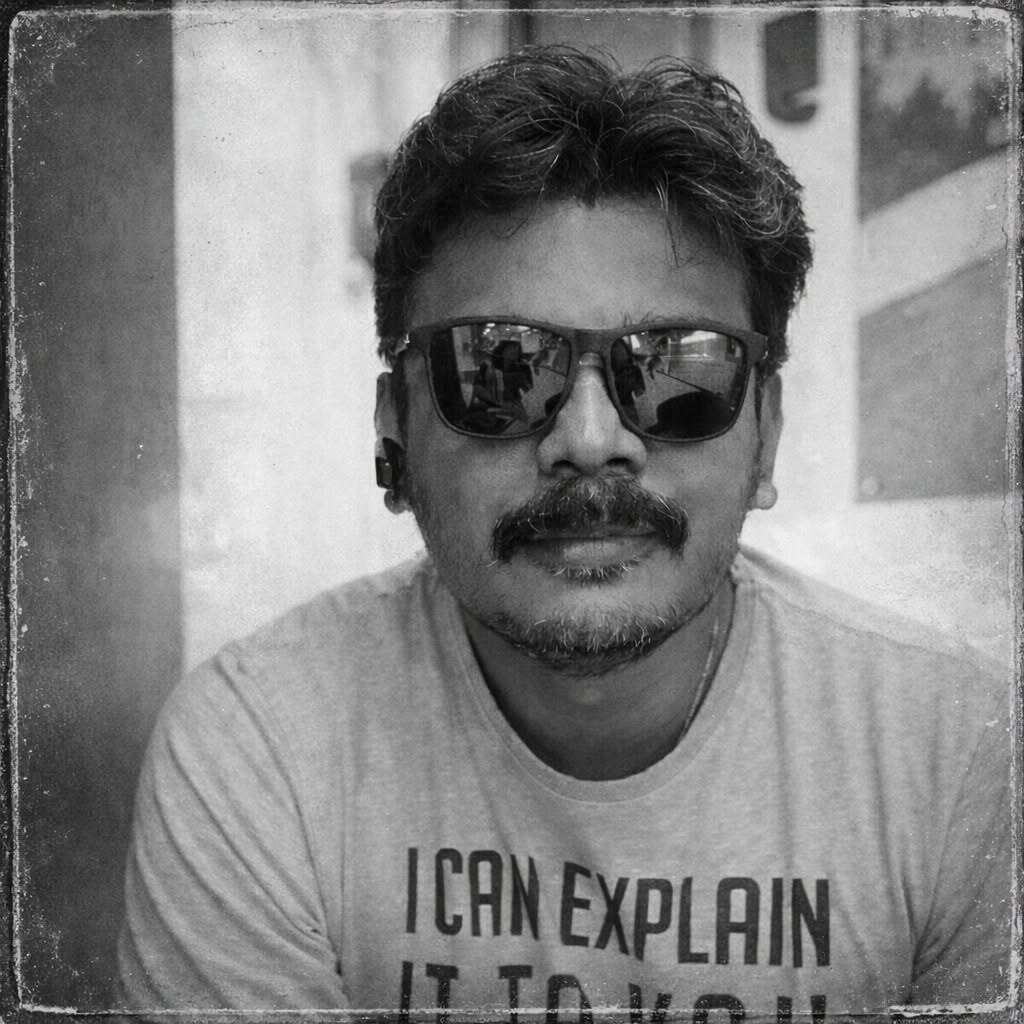
I'm Sakthi — Shak, if you're reading this on the Journal — based in Bangalore. My career started in 1994 as a Customer Support Executive, and by the time I stepped away in 2026 it had grown into thirty-two years of work — a long, winding road that eventually landed me as a network and enterprise architect. Along the way I crossed paths with more teams, managers, and companies than I could ever list here, and every one of them left something behind — a habit, a way of thinking, a lesson learned the hard way — that quietly shaped how I still approach structure, people, and getting things done properly. The fascination with markets itself goes back even further — nearly twenty-five years, to watching a friend trade and move money around with an ease that genuinely mesmerized me at the time. I didn't do anything about it back then. It just sat quietly at the back of my mind through two decades of network architecture, the way an old fascination does, waiting for room it hadn't found yet.
Before I go further, one thing deserves to be said properly: I was also fortunate with the people I worked alongside — two different teams across my last two projects, each one genuinely good in its own way, for different reasons. None of what got built in those years was really one person's doing; it was team effort, start to finish, and I'm grateful for that as much as anything else. Thank you, sincerely, to all of you.
I've been fortunate in another way too, and I don't think that's true for most people in corporate life. For the last ten years, I had the privilege of working with a manager who made that entire stretch of my career something I still look back on with real gratitude — not because the work itself was always easy, but because there was a rare kind of mutual respect in how we worked together. In a corporate world that runs thick with politics, egos, and people managing upward more than managing well, a manager who actually understands you is genuinely hard to come by. When the time came for me to step away from a stable, well-paying role — to take care of my health and finally make room for the things I was actually passionate about — he met that decision with quiet understanding rather than resistance. That kind of grace is not common, and I've never forgotten it.
That room finally showed up when I stepped away, and the old fascination came back almost immediately — except this time I actually had the hours to do something about it. I started the only way anyone honestly does: books, a lot of them, followed by a long and genuinely humbling stretch of trial and error. Strategies that looked airtight on paper fell apart the moment real money and real emotion got involved. Most of what I tried in that first year, I'd quietly retire within a few weeks.
The books that actually stuck are still on my desk, and I've written up every one of them on the Trader's Bookshelf. Frank Ochoa's Secrets of a Pivot Boss came first and is still the one I keep going back to — the CPR and pivot methodology that everything else got built around. From there it was Wyckoff, in stages: the original course material, then David Weis's Trades About to Happen and the modern Wyckoff Power Charting, which is what finally taught me to read volume as intent instead of just noise. Tom Williams' Volume Spread Analysis and Anna Coulling's more accessible take on the same ideas rounded that piece out. Stan Weinstein's work on relative strength changed which breakouts I actually trust. Steidlmayer and Jim Dalton gave me Market Profile — the framework behind every Daily Recap chart on this site — and Giovanni Trapani's book on order flow is what finally let me read a footprint chart properly instead of just staring at it. And Mark Douglas's Trading in the Zone belongs in a category of its own — every technical framework on that shelf is only as good as your ability to actually sit still and execute it, and that book is the reason the rest of it gets used at all.
What I actually combined, out of all of that, was the CPR and pivot methodology with order flow, market profile, and volume analysis — not as indicators to stack on a chart, but as a way to locate where a trade actually belongs before taking it. CPR gives you the map. Order flow tells you where the real contest is happening. Put together, they tell you where to actually stand. The full setup is written up in the Trading Framework post. The Daily Recap here is the post-market half of that discipline — a read on the session after it closes, not a morning call. The live automated strategy built on that same framework gets its own running log too, on the Algo Scorecard.
The discipline itself didn't start with trading — it's just the thing thirty-two years in networking leaves you with, whether you go looking for it or not: resilience only works if it's designed in from the first decision, not patched on after something breaks. I don't take on that kind of work actively anymore, but the instinct hasn't gone anywhere. Nobody notices a network when it's working. The same is basically true of a good trading structure — the whole point is that it holds up quietly, without anyone, including me, needing to watch it too closely.
That same instinct is also why I still watch the networking industry as closely as I watch markets — not nostalgia, just the field that shaped how I think about everything else. Packet & Parameter is where that shows up on this site: a weekly deep-dive on one story in AI or networking that actually mattered, not an attempt to cover everything.
Peace is not the absence of complexity — it is the discipline to structure it.
I didn't arrive at this from a book. It's the pattern I keep noticing in myself — calmer, not more anxious, once something complicated has real structure under it. A messy trade, a messy network, a messy decision — the fix is never rushing, it's slowing down long enough to see the shape of the thing. I'm not chasing speed anywhere in my life right now. I'm chasing the kind of precision that's still standing after a bad week, not just a good one.
Outside markets and screens, I document places through photography — mostly temples, good light, and whatever else has the decency to look interesting when I happen to have a camera on me. Annamalaiyar Temple in Tiruvannamalai is the one I keep returning to, with a full write-up on why in the Journal. The Lens isn't a portfolio in the formal sense — it's closer to a running record of what's actually caught my attention, opportunism included.
Gear notes and what's shot on — one body, one lens, and what's coming next — are over on The Lens.
This is a personal journal, not a service or a consulting practice. I'm not taking on network architecture work, and nothing here is investment advice — trading posts are personal research notes, stated as such every time. If you want to reach out, the contact form goes straight to me.