
What ₹30 Lakh From 2016 Actually Became — And Why I Sold Anyway
I found an old portfolio screenshot a few days ago. Six stocks, bought in 2016 and 2017, back when ₹30 lakh felt like a serious amount of money to put into the market — because it was. I don't own any of them today. I sold every one, at different points, and for years I never bothered doing the math on what that decision actually cost.
So I did it. And the number is uncomfortable enough that I want to tell the story properly instead of just posting a chart and moving on.
The number
₹30,71,579, spread across six ordinary large-cap names — Ajanta Pharma, Bajaj Finance, Eicher Motors, Kajaria Ceramics, Page Industries, Mindtree. Nothing exotic. I bought them the way most first-time investors buy their first serious portfolio: a mix of conviction, article-reading, and mild peer pressure.
Three of those six positions — Bajaj Finance, Eicher Motors, Mindtree — were opened within 48 hours of one of the most disruptive economic shocks in modern Indian market history. On the evening of November 8, 2016, the government demonetised 86% of India's currency in circulation overnight. This wasn't a soft news cycle — the Nifty fell 6.33% the very next trading session, the Sensex 6.12%, one of the sharpest single-day national shocks of the entire decade. I bought into that same week, not because I was making some contrarian bet on chaos — I genuinely didn't know enough to have an opinion — but because that's simply when I happened to start. This portfolio's first days on earth were spent inside a real, sharp national crash, not a mild wobble, and it still ended up here. Worth remembering the next time a single news cycle feels like a reason to not invest at all.
Had I never sold, that ₹30.7L would be worth roughly ₹1.5 crore today — market value plus dividends collected along the way. Call it 390%, just under 5x, over nine years.
The Nifty 50 itself — no stock-picking at all, just the index — returned about 203% over the same stretch. So picking these six specifically did matter. It roughly doubled what the index alone would have handed me.
Here's what that actually looked like, plotted against the index the whole way:
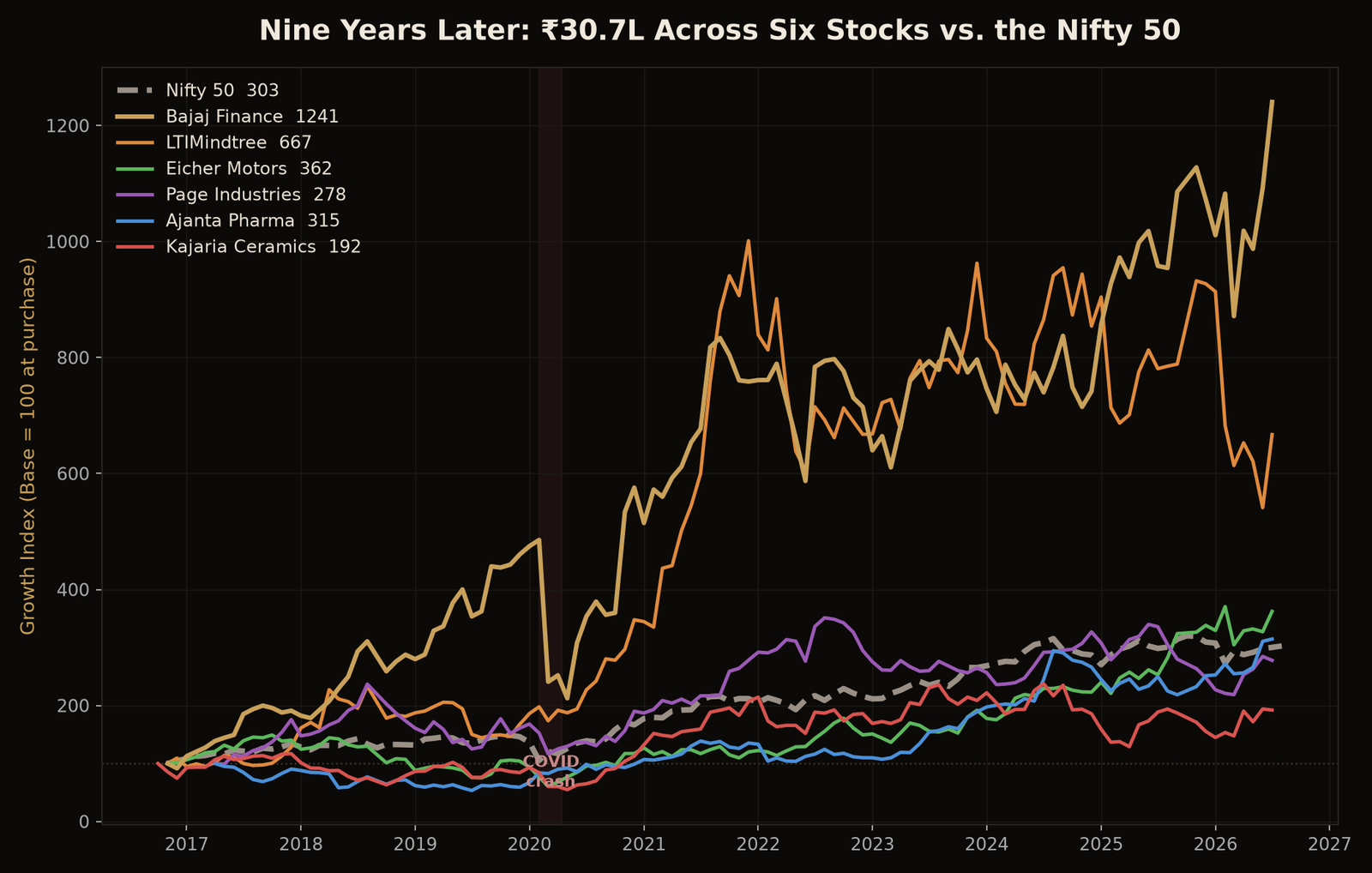
That gold line pulling away from everything else is Bajaj Finance. Everything below the dashed grey Nifty line, for most of the decade, is the other five — perfectly respectable, mostly index-hugging, nothing special. One stock is doing almost all of the outperformance in that 390% number. Which is the first real lesson here, and it's not the one I expected to write.
Staying invested gets you the market. Picking well gets you the difference.
Look at that chart again. For the first four or five years, five of these six lines are basically tracking the Nifty — sometimes a little above, sometimes a little below, nothing that would have felt like genius in real time. If I'd only held the average of these six stocks, I'd have beaten the index by a modest, forgettable amount. Staying invested was doing almost all of the work.
Bajaj Finance is the outlier that changes the whole story — a 12.4x return, more than the other five combined. And the uncomfortable part is that I didn't earn that by being a great stock-picker. The stock went through two separate splits and bonus issues over nine years, the kind of corporate action that quietly multiplies your share count while the price on your screen barely moves. In sticker terms, Bajaj Finance went from around ₹900 to ₹1,150 — a return so unremarkable you'd scroll past it on a stock screener. But that ₹1,150 is only what the price shows after the stock was carved into 10x as many shares along the way. Undo that split arithmetic and price the same original share today, and you're not looking at ₹1,150 — you're looking at roughly ₹11,500. That's the real number a ₹900 share actually became. The screen just never shows it to you, because the split resets the price back down every time the multiplication happens.
So both things are true at once, and I think this is the actual finding: staying invested is what gets you the market's return. But which six stocks you pick is what decides whether you get the market's return, or something several times larger. Diversification protects you from being wrong. It doesn't stop you from being right in a way that changes everything — you just need one.
The crashes that would have tested all of it
Nine years is long enough to include more than one real scare, and this portfolio's timeline runs straight through a genuinely long list of them — market-specific shocks, three separate wars, and three separate Budgets that each drew real blood.
The first is the one most people forget was ever this bad: the IL&FS default of September 2018, which blew a hole through India's NBFC sector specifically. The Nifty fell a comparatively mild 15% over the following weeks — but Bajaj Finance, the exact stock carrying most of this portfolio's return, is an NBFC, and NBFCs were the epicenter. In four trading days that September, Bajaj Finance alone lost close to ₹13,800 crore of market cap. If there was ever a moment to panic-sell the one stock that would go on to return 12.4x, that week was it — the news was directly about companies exactly like the one you were holding.
The second is the one everyone remembers: the COVID crash, Nifty down 38% in 45 trading days, bottoming March 23, 2020. You can see it on the chart — a visible dent across every single line, Bajaj Finance down over 50% in that one month alone, worse than the broader index.
The third is the strangest one, because it wasn't even about the economy — it was about an exit poll. On June 4, 2024, election results day, the Nifty fell nearly 6% in a single session as early trends suggested a far narrower mandate than the exit polls had predicted. It was one of the sharpest one-day falls in years, pure sentiment whiplash, and it fully reversed within days once the actual coalition numbers settled. A genuine reminder that some of the scariest single days have nothing to do with the businesses you actually own.
Then there are the wars — three of them, each landing on the market within days of the first shot. Russia invaded Ukraine on February 24, 2022, and the Nifty fell roughly 6.3% in the week that followed, one of the sharpest weekly drops of that entire year. Hamas attacked Israel on October 7, 2023, and by month's end the Nifty had posted its worst monthly decline in ten months, with roughly ₹7.6 lakh crore of investor wealth erased across the market. And most recently, the same Iran-Israel-US conflict that closed the Strait of Hormuz and sent Brent crude from $69 toward $157 a barrel is what actually drove the 2026 correction mentioned earlier — a market shock with a war sitting directly underneath it, not just an oil-price story. Three separate wars, three separate years, and in every case the Nifty moved hard within days.
And then there's the Budget — India's own, entirely homegrown source of market shocks, three separate times. February 1, 2018: the reintroduction of long-term capital gains tax on equities sent the Sensex down 839 points the next session, at the time described as the steepest fall since demonetisation — the same event that opened this whole portfolio's story. July 5, 2019: a surcharge on high earners that inadvertently hit foreign portfolio investors sent the Nifty down 2.14% on Budget day itself, then further into the worst weekly fall in nine months as the FPI implications became clear. February 1, 2020: the worst Budget-day fall in eleven years, Nifty down 2.51%, roughly ₹3.6 lakh crore of wealth gone in a single session — weeks before COVID would make that number look almost quaint.
And that's still not the whole list. Nine years of holding real money in the market means living through a genuinely long tail of smaller shocks too — none of them alone would justify a whole section, but together they're worth just naming, so the sheer volume of noise a long-term holder has to sit through is honest rather than sanitized:
- March 6, 2020 — the Yes Bank crisis, RBI takes control of the bank overnight, Nifty falls ~3.2–3.9% in a single session (landing right inside the COVID window).
- April 2021 — India's second COVID wave, record daily case counts, Nifty down ~6% from its February peak over several weeks.
- January 27, 2023 — the Adani-Hindenburg report, Nifty falls 1.61% in a day, the Adani group loses roughly $50 billion in market value in the first two sessions alone, growing to around $150 billion over the following weeks — this is the exact kind of fraud-allegation shock I was quietly afraid of back in 2016, just landing on a different conglomerate, years later.
- September 2024 – March 2025 — an extended, grinding selloff driven by election uncertainty, weak corporate earnings, and sustained foreign investor outflows; the Nifty fell roughly 13% over that stretch, not in one dramatic day but in the much harder-to-sit-through way a market can just quietly bleed for months.
- April 7, 2025 — the US announces sweeping "reciprocal tariffs" on Indian exports, and the Nifty falls roughly 5% in a single session, one of the sharpest one-day drops of the entire decade.
- March 19, 2026 — a session Nifty falls roughly 3.3%, part of the broader volatility feeding into the oil-shock correction covered above.
- July 8, 2026 — the most recent entry on this list, a single-day fall described as the worst since March of that same year, roughly ₹9 lakh crore of wealth erased in one session.
None of these were mine by the time any of them happened; I'd already sold, on my own timeline, well before every single one. But running this honestly means asking the harder question anyway: if I'd still held through every year on that list — nearly every single year of the nine, it turns out — would I have? I don't know. That uncertainty is the actual point. Nobody's 4.9x return gets made in the good years. It gets made in the dozens of weeks across a decade where the news is specifically about the thing you own — or about a war, or a Budget speech, or a bank, or a tariff announcement, thousands of kilometers from anything the business itself actually does — and staying still feels like the wrong decision, over and over again.
The harder test wasn't the crashes. It was the years of nothing.
Crashes are at least dramatic — there's a headline, a reason, an ending. Look at the chart again and you'll notice something quieter and, I think, actually harder to sit through: Ajanta Pharma and Kajaria Ceramics spent close to three full years, 2017 through 2019, doing basically nothing. Not falling off a cliff. Just drifting sideways, sometimes a little below where they started, with no news event to blame and no obvious moment where things would turn.
A crash at least gives you a story to tell yourself — "the market's panicking, this will pass." Three flat years gives you nothing to hold onto except the original decision to buy, slowly eroding under boredom. Both of those stocks eventually woke up and multiplied several times over from there. But if you'd sold in year two out of sheer restlessness — which, if I'm honest, is exactly the kind of decision I actually made back then — you'd never have found out. A crash tests your nerve for a few weeks. A flat stretch tests your patience for years, and patience is the harder muscle to hold.
Why I sold — and why I'm not sorry
Notice the pattern across every one of those shocks above: none of them were really about the businesses. IL&FS was about NBFC contagion fear, not whether Bajaj Finance's loan book was actually sound. COVID was macro terror, not a verdict on Eicher Motors' motorcycles. The 2024 election day move was pure sentiment whiplash over an exit poll that turned out to be wrong. The three wars were thousands of kilometers from anything any of these six companies actually did. The three Budgets were tax-policy decisions, not earnings reports. The market spends most of its violent moments reacting to sentiment, not to the thing you actually own — and I was, back then, a purely sentiment-driven investor myself. Which is really what this whole section is about.
Back then I wasn't trading. I didn't know what order flow was. I couldn't have told you what a market profile looked like. I was a complete amateur, and the honest truth is I was excited for reasons I couldn't explain — the market went up, my portfolio went up with it, and that feeling of money appearing without understanding why is what actually pulled me in deeper. It's what made me start digging. Why did this move today. What is a P/E ratio, actually. That question is the real seed of everything I do now — the trading, the writing, all of it traces back to refusing to leave "I don't know why this went up" unanswered.
I was clever about one thing: I diversified, six sectors, not one story. But underneath that was a fear I never said out loud — what if one of these turns out to be a fraud, what if the numbers are cooked and I find out the hard way. That fear wasn't irrational, even if my response to it was — the Adani-Hindenburg report in January 2023 eventually wiped out roughly $150 billion of market value from a different conglomerate over the following weeks, on exactly that kind of allegation. I just happened to be worried about the wrong stocks, years too early, for reasons I couldn't articulate at the time. I didn't have the knowledge to actually evaluate real fraud risk, so instead of learning how to, I did the amateur thing. I looked for quick wins. A stock up 30-40% felt like proof I'd been right, and selling it felt like safety — getting out before whatever I was quietly afraid of had a chance to happen. There's a name for this, I'd later learn: the disposition effect, the well-documented tendency to sell winners too early and hold losers too long, because a win banked feels like relief and a loss on paper doesn't feel real until you realize it. That's not conviction. That's a known, common bias, dressed up as a decision.
I think almost every amateur does some version of this early on, and most look back with regret — the classic if only I'd held story. I genuinely don't have that regret. I paid a price for not knowing what I was doing, and the price was this ₹1.5 crore counterfactual. But paying it is exactly what sent me looking for the frameworks that actually explain why a market moves instead of just watching the number and feeling something — order flow, market structure, the whole way I read a session now. I evaluated a lot of ideas along the way and kept only what held up under real scrutiny, which is its own framework I've since written about. None of that exists without this exact mistake happening first. So in the end, it's hard to call it a loss.
One honest caveat before I close this out: this is one past, not a formula. Six stocks, zero total losses, one 12x outlier carrying the rest — that's a genuinely lucky distribution, and I'd be doing you a disservice if I let this read as "just buy six stocks and hold for nine years, guaranteed." Plenty of six-stock portfolios from 2016 would have had a Yes Bank or a DHFL in them instead of a Bajaj Finance, and this whole article would read very differently. The lesson isn't "picking stocks works." It's narrower than that: staying invested is the reliable part, available to anyone who does it. Which specific stocks reward that patience is not something you get to know in advance, and I don't want to pretend otherwise.
What actually changes
Nothing dramatic. I'm not buying back six stocks and swearing off selling forever. But there's one real thing I'm taking from this: before the next long-term position goes on, I write down the actual business reason I'd exit — not a price level, not a feeling — the same discipline I already hold myself to on every trade the algo takes. If that habit made the trading side of my portfolio more honest, there's no reason it shouldn't apply to the ₹30-lakh decisions too, not just the ₹40,000 ones.
The market didn't need me to be clever with these six stocks. It needed me to be quiet, and pick at least one of them right. I managed the second part. The first part is what I'm still working on.
Drop me a note if you've run this same math on your own old portfolio — I'd genuinely like to know if the number surprised you as much as mine surprised me. And if you're actually thinking about building a long-term portfolio of your own and want a second pair of eyes on the picks, reach out — happy to talk it through over coffee.
— Shak